
Test Methods for Evaluating Bacteria in Water Samples: Why Results Can Differ
Waterlines and water delivery systems are typically engineered for function—not microbiology. Long, narrow tubing and periods of stagnation make water channels prone to biofilm. That’s why a dependable water management program has two parts: continuous treatment and routine verification testing.
Jump to:
Background Context for Bacteria Test Methods
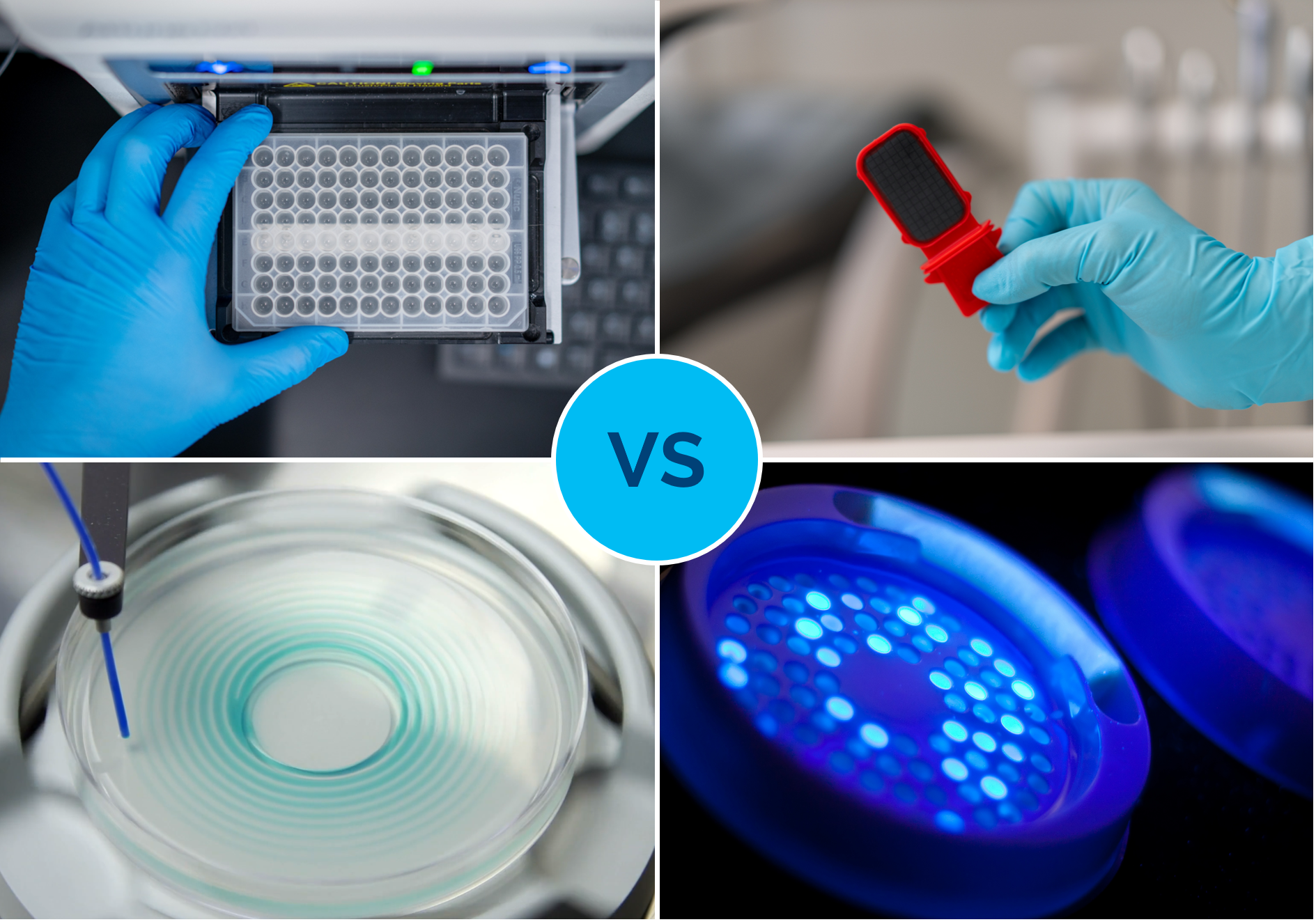
When you compare testing options, it is helpful to sort them into two buckets:
Mail‑In Laboratory Testing: best for accuracy, documentation, and defensible results. These tests generally involve collecting your water sample in a sterile vial and shipping the vial into a 3rd party lab. After processing the sample through your selected method, the lab provides a certified results report.
In-Office Testing: best for fast feedback and trending between lab tests. In-office tests are lower fidelity tests that allow for a quick check in between mail-in tests. These are generally the most affordable option but are also the least accurate.
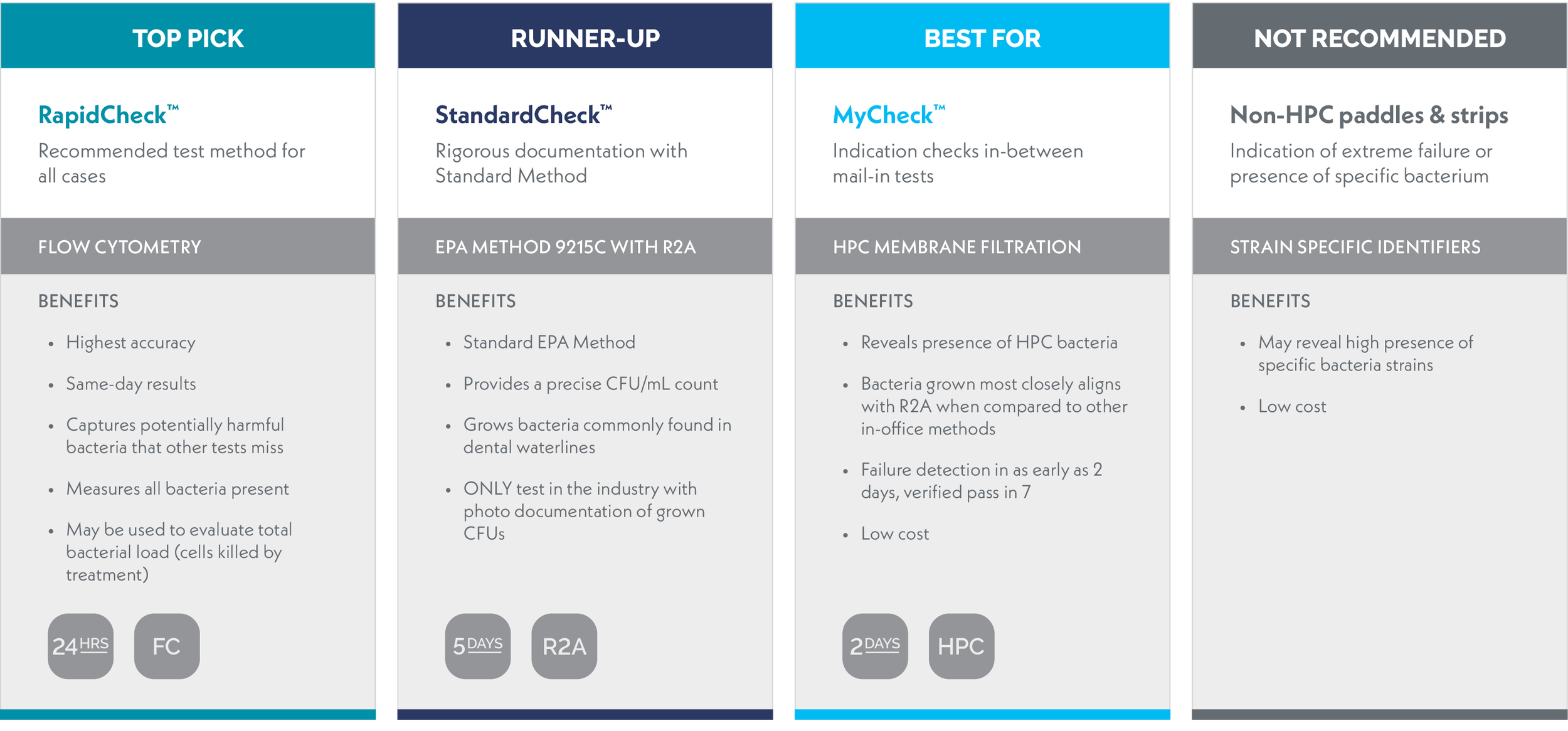
Below is a practical breakdown of what each test type measures, when it’s most useful, and what it can (and can’t) tell you.
Summary Guide
Background Context for Bacteria Test Methods
Before diving in, it is useful to understand what we’re measuring – a Colony Forming Unit (CFU). When you look at a water sample, the bacteria are way too small to see and count. Traditional test methods culture the bacteria by feeding them and giving them an environment they like growing in. As the bacteria multiply, they create clusters aka colonies. Once those colonies are large enough, we can see them and count them! Each colony indicates there was previously bacteria that had the ability to grow and form said colony, hence we call them Colony Forming Units.
Why All Test Methods Are NOT Created Equal
Did you know? If you test the same water sample with each test method, you may (and probably will) get different results. One reason different tests don’t always agree is that some bacteria are alive but won’t grow within specific tests. That’s why a paddle, a lab culture, and flow cytometry may produce different numbers from the same sample. Below is an explanation of the important categories waterborne bacteria fall into.
Culturable vs Non‑Culturable
Culture‑based heterotrophic plate count (HPC) methods estimate live, culturable heterotrophic bacteria. When the individual colonies are visible and can be counted, the results are reported as a precise CFU/mL - colony forming units per milliliter of water. Some methods culture the bacteria, but the individual colonies are not visible. These methods usually report the CFU/mL as a ‘Most Probable Number’ (MPN).
Part of ‘culturing’ the bacteria is feeding them with what is called nutrient media. Different test methods often use different nutrient media or “food” for the bacteria. This difference in food usually doesn’t work for all the bacteria present and as a result, only a subset of culturable bacteria grows.
Some bacteria, even though they are alive, don’t grow on these traditional nutrient medias at all. This has important implications for water testing in the healthcare industry as many potentially harmful cells (like Legionella or Pseudomonas) fall into the Non-Culturable category. Cultivation‑independent methods (like flow cytometry) can detect these bacteria that do not readily grow on standard media.
Viable vs Non‑Viable
Viable bacteria are bacteria that are still living and capable of reproducing and spreading. Non-viable bacteria are dead cells and pieces of those cells that will not reproduce but can still illicit immune responses and contain harmful toxins. The important thing to remember is that not every test looks at bacteria the same way. Most tests only show some of the bacteria that are alive and able to grow. Other tests can give a bigger picture of what is in the water sample, including all bacteria that are alive, regardless of their growth rate. And some tests can even include the dead (non-viable) bacteria.
A simple way to think about it is this: hand sanitizer actively kills bacteria but doesn’t necessarily remove it from your hands. Hand soap will help lift those germs (dead and alive) off your hands. A water test that measures viable and non-viable bacteria will tell you how many living and dead cells are in your water. Just like you want to kill and remove bacteria from your hands, reducing both numbers from your water indicates a strong comprehensive protocol.
It is important to note that non-viable bacteria are not included in the reported count of bacteria – that means they do not contribute to passing or failing a water quality standard. Having access to a non-viable count simply gives you more information to work with to make effective and informed decisions.
Mail‑In Laboratory Testing
Best for Rigorous Compliance Documentation
Mail‑in testing is usually the right choice when you need consistent, well‑documented results, especially when confirming compliance with waterline quality requirements such as the CDC benchmark of ≤500 CFU/mL for dental treatment water or ANSI/AAMI ST:108 guidelines for sterile processing water.
1) Flow Cytometry - RapidCheck
RapidCheck uses flow cytometry to look at bacteria directly instead of waiting for them to grow into visible colonies. The water sample is treated with special dyes that attach to bacterial cells. The sample then passes through a laser-based instrument, where each cell creates a signal that can be counted. This gives a fast picture of the bacteria present in the sample, including cells that may not grow well on traditional culture tests. Because customers are used to seeing results in CFU/mL, RapidCheck results are correlated to an R2A culture result and reported as a CFU/mL range rather than one exact colony count.
Why Practices Choose Flow Cytometry
RapidCheck is useful when a practice wants fast, accurate insight into what is happening in the water sample. Because it looks for bacteria directly, it can give a more complete picture than culture-based methods and helps reduce the chance of a false pass. That is why Agenics recommends RapidCheck as the best first choice when accuracy matters.
Time to Results: 1 Day
Certified Results Report: Yes
EPA Method: No
Additional Metrics: TDS, pH
Result Type: Correlated CFU/mL Range
2) EPA Method 9215c Using R2A - StandardCheck
StandardCheck is a culture-based test. In simple terms, a measured amount of the water sample is placed on the surface of an R2A agar plate. R2A is a low-nutrient growth surface that is designed for bacteria commonly found in treated water. The plate is incubated for several days so bacteria that are able to grow can multiply into visible colonies. After incubation, the colonies are counted and the result is reported as CFU/mL, or colony forming units per milliliter.
Why Practices Choose R2A
R2A is a strong fit for waterline testing because it is designed for the types of bacteria often found in treated waterlines. Some bacteria grow slowly or may be stressed from routine waterline treatment, so R2A gives them more time and a better environment to grow. This helps provide a useful CFU/mL result for tracking whether a waterline maintenance program is working. For practices that need clear documentation tied to specific CFU/mL benchmarks, StandardCheck offers a practical and defensible way to verify water quality over time. Many healthcare professionals value the precise CFU/mL count that StandardCheck provides, since not all R2A-based options provide the same level of count detail.
To learn more about StandardCheck and R2A testing, see our blog.
Time to Results: 5 Days
Certified Results Report: Yes
EPA Method: Yes
Additional Metrics: TDS, pH
Result Type: Precise CFU/mL
3) EPA Method 9215e Enzyme Substrate - SimCheck
Enzyme substrate testing estimates bacteria levels in a water sample by looking for specific enzyme activity. The sample reacts with special dyes that can change color or glow under blacklight when certain bacteria are present. Unlike R2A culture testing, this method is not growing and counting actual visible colonies. Because of that, the result is reported as an estimated number, called a Most Probable Number, or MPN, rather than a precise CFU/mL colony count.
Why Practices Choose Enzyme Substrate
SimCheck testing can be useful when you want a general look at source water, such as municipal or well water, before it reaches the chair. It can help show broad trends in incoming water quality over time. However, because it is an estimate and does not count actual colonies, it is generally less accurate than StandardCheck or RapidCheck. This means it may miss some issues and can sometimes give a false pass. For that reason, it is best used as a general monitoring tool, not as the top choice for waterline verification.
Time to Results: 2 Days
Certified Results Report: Yes
EPA Method: Yes
Additional Metrics: TDS, pH
Result Type: Estimated CFU/mL MPN
In‑Office Testing
Best For Spot Checks & Low Risk Lines
In‑office testing is ideal when your team needs quick feedback after maintenance, shocks, source‑water changes, or a suspected lapse in protocol. All manual in-office methods are less accurate than mail-in tests and prone to false passes. As such, they should always be used in conjunction with mail-in tests.
In general, in-office methods should not be used when first validating a waterline management protocol and are best used after establishing consistent passing results with mail-in tests.
1) Broad-Recovery HPC Paddles - MyCheck
Paddles are a practical in-office option when a facility wants quick feedback between mail-in tests. MyCheck is a culture-based method, meaning bacteria are given nutrient medium and incubation conditions that allow them to grow so general bacterial trends can be evaluated. Compared with other in-office methods, MyCheck most closely aligns with mail-in R2A testing because its nutrient medium and incubation conditions are designed to better support broad heterotrophic recovery. They can help your team spot trends after maintenance, treatment changes, shocks, or unexpected results. Because in-office testing is not as controlled as lab testing, paddle results may not always match Flow Cytometry or R2A results. Paddles are best used as a simple trend tool between lab submissions.
2) Narrow‑Spectrum & Enzyme Based Paddles
Paddle type matters. Not all in-office paddles are designed to look for bacteria in the same way. For overall waterline health, broad-recovery paddles are more useful because they are designed to show a wider range of bacteria that may be present in treated water (like MyCheck). Narrow-spectrum paddles may focus on a smaller group of or very specific bacteria and can give a false reassurance if other bacteria are present but not well detected by that paddle.
Some dip paddles also rely on enzymes produced by the digestive or respiratory process of specific bacteria rather than culturing the bacteria into visible colony forming units. For routine in-office trending, choose a paddle designed for broad heterotrophic recovery so that the result more closely aligns with mail-in tests and supports your overall waterline monitoring program.
3) Water Test Strips (Screening Only, Not Microbial Verification)
Water test strips can be helpful for quick checks of specific water conditions such as E. coli or chlorine, but they should not be used as overall microbial verification. They do not provide a bacteria count, such as CFU/mL or MPN, and they cannot confirm whether a waterline treatment program is controlling bacteria. Test strips are best used as a simple support tool alongside a broader waterline monitoring program, not as a replacement for RapidCheck, StandardCheck, or MyCheck.
Which Option Should A Practice Choose?
For the most complete picture of waterline bacteria, Agenics recommends RapidCheck as the top choice. RapidCheck uses flow cytometry to provide highly accurate, same-day insight into the bacteria present in the sample, including bacteria that may be missed by culture-based methods because they do not grow well on plates. When a facility needs additional troubleshooting support, the Agenics team can even use RapidCheck to assess the total microbial load of the source water. By looking at non-viable (dead) cells, Agenics can help establish how well a treatment protocol is performing relative to the quality of water coming into the system.
When a practice needs rigid documentation, photos, and a precise CFU/mL culture count, StandardCheck is the best fit. StandardCheck uses EPA Method 9215c with R2A and is helpful when a practice wants clear, defensible records. Because StandardCheck includes photos of the cultured plates, it is also a great educational tool for helping teams understand what can be going on within water.
For fast feedback between mail-in tests, MyCheck paddles are a practical option. They help give your team an early indication of general waterline health, especially after maintenance, treatment changes, or unexpected results. MyCheck is not meant to replace RapidCheck or StandardCheck, but it can help you spot trends early and decide when a follow-up lab test may be needed.
I Passed an In-Office Test But Failed a Mail-In Test – Why?
Sometimes, a water sample may pass on in-office tests but fail a mail-in test. While it can be tempting to believe the ‘Pass’ and assume something went wrong with the mail-in test, that is rarely ever the case. The graphic below shows why different test methods can give different results from the same water sample. The largest circle represents all of the viable bacteria that may be found in a waterline. The other circles represent the various test methods available and demonstrate that different tests are only capable of capture a subset of bacteria potentially present.
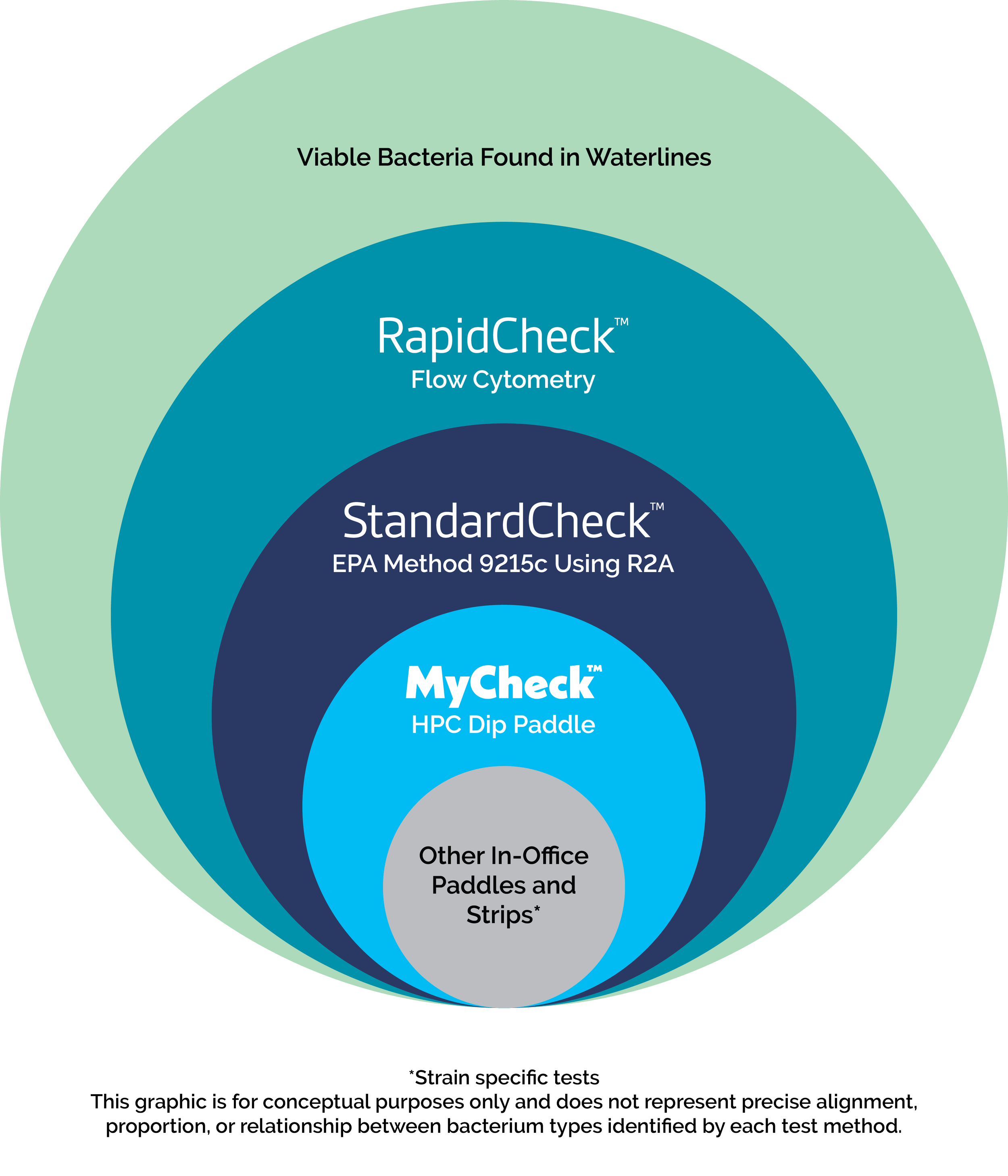
RapidCheck captures the broadest view because it looks for viable bacteria directly instead of waiting for them to grow and captures bacteria that may not grow at all on other culture-based tests. Agenics then correlates the RapidCheck result to R2A so it can be reported in a CFU/mL format customers are used to seeing. This correlation means the reported number is typically a little lower than the total viable bacteria present.
StandardCheck uses R2A culture method and provides strong documentation, photos, and a precise CFU/mL count, but it still captures a smaller subset of bacteria because only bacteria that grow well on R2A are counted. Think of the R2A nutrient as pet food - if you feed all your pets fish food, your fish will grow happy and healthy, but your other pets may not eat at all!
MyCheck paddles are still looking at HPC bacteria, but they use a different nutrient source and generally recover fewer bacteria strains than R2A. Other common strips or narrow tests may only support one or a few specific organisms, so they capture even less of the full picture.
The key point is simple: if bacteria are growing in the waterline, that is evidence the environment may support other bacteria too. The fewer types of bacteria a test can capture, the greater the chance it may miss an issue and give a false pass. That is why Agenics recommends RapidCheck first for the most complete view, StandardCheck when rigid documentation is needed, and MyCheck as a helpful trend tool in-between mail-in tests.
Bottom line
No single test method explains waterline health in the same way. RapidCheck is the best first choice when you want the most complete and accurate view of bacteria in the sample. StandardCheck is best when you need specific CFU/mL counts, and MyCheck is helpful for quick indication checks in-between mail-in tests. The right testing plan depends on whether your practice needs rapid insight, rigid documentation, or simple trend monitoring between lab submissions.
-
American Dental Association. (2024). Dental unit waterlines. https://www.ada.org/resources/ada-library/oral-health-topics/dental-unit-waterlines
Centers for Disease Control and Prevention. (2024, May 15). Best practices for dental unit water quality. https://www.cdc.gov/dental-infection-control/hcp/dental-ipc-faqs/best-practices-dental-unit-water-quality.html
Prest, E. I., Hammes, F., Kötzsch, S., van Loosdrecht, M. C. M., & Vrouwenvelder, J. S. (2013). Monitoring microbiological changes in drinking water systems using a fast and reproducible flow cytometric method. Water Research, 47(19), 7131–7142. https://doi.org/10.1016/j.watres.2013.07.051
Reasoner, D. J., & Geldreich, E. E. (1985). A new medium for the enumeration and subculture of bacteria from potable water. Applied and Environmental Microbiology, 49(1), 1–7. https://pmc.ncbi.nlm.nih.gov/articles/PMC238333/
U.S. Environmental Protection Agency. (n.d.). 9215 Heterotrophic plate count (Standard Methods excerpt). Regulations.gov. https://downloads.regulations.gov/EPA-HQ-OW-2014-0408-0021/content.pdf
Hammes, F., & Egli, T. (2010). Cytometric methods for measuring bacteria in water: Advantages, pitfalls and applications. Analytical and Bioanalytical Chemistry. (PDF hosted by BWT).
Government of British Columbia. (2017, December 8). Determination of heterotrophic plate count (HPC) in water by pour plate, spread plate, membrane filtration and enzyme substrate test methods. https://www2.gov.bc.ca/assets/gov/environment/research-monitoring-and-reporting/monitoring/emre/methods/heterotrophic_plate_count_by_membrane_filtration_2017dec08_edits.pdf